
Ashtalakshmi Stotram
अष्टलक्ष्मी स्तोत्रम्|Aṣṭalakṣmī Stotram|Hymn to the Eight Lakshmis
Also known as: Ashtalakshmi Stotra · Eight Forms of Lakshmi Hymn
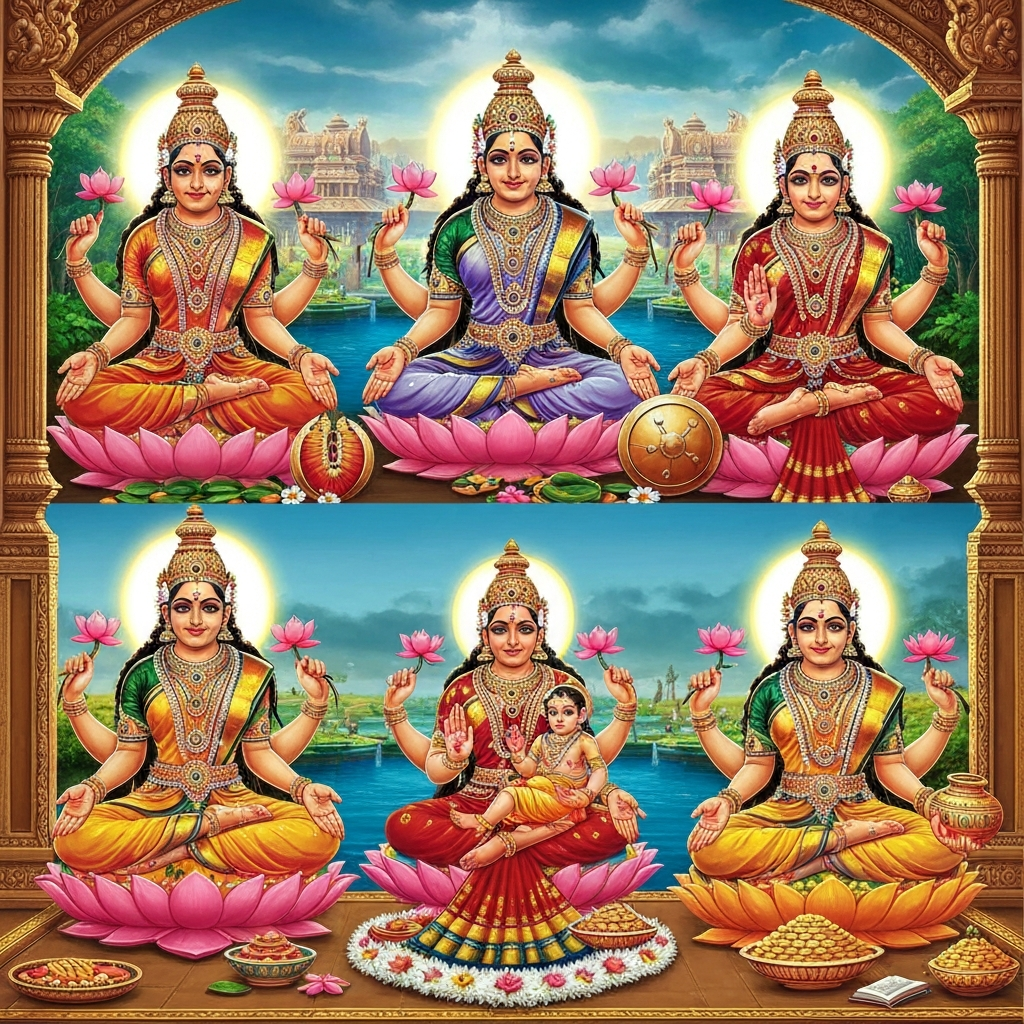
Cover image generated by AI · #Greetingify · #SocialBotStudio
सुमनसवन्दित सुन्दरि माधवि चन्द्र सहोदरि हेममये। मुनिगणमण्डित मोक्षप्रदायिनि मञ्जुलभाषिणि वेदनुते॥ पङ्कजवासिनि देवसुपूजित सद्गुणवर्षिणि शान्तियुते। जय जय हे मधुसूदन कामिनि अष्टलक्ष्मी परिपालय माम्॥१॥ अयिकलि कल्मषनाशिनि कामिनि वैदिकरूपिणि वेदमये। क्षीर समुद्भव मङ्गल रूपिणि मन्त्रनिवासिनि मन्त्रनुते॥ मङ्गलदायिनि अम्बुजवासिनि देवगणाश्रित पादयुते। जय जय हे मधुसूदन कामिनि अष्टलक्ष्मी परिपालय माम्॥२॥ जयवरवर्षिणि शूलिनि शुभ्रगुणे वरजासिनि शान्तियुते। सकलदुरितहरिणि प्रत्यक्षफलदे जय जय हे मधुसूदन कामिनि अष्टलक्ष्मी परिपालय माम्॥३॥ जय जय दुर्गतिनाशिनि कामिनि सर्वफलप्रद शास्त्रमये। रथगजतुरगपदाति समावृत परिजनमण्डित लोकनुते॥ हरिहरब्रह्मसुपूजित सेवित ताप निवारिणि पादयुते। जय जय हे मधुसूदन कामिनि अष्टलक्ष्मी परिपालय माम्॥४॥ जय जय हे मधुसूदन कामिनि अष्टलक्ष्मी परिपालय माम्॥५॥ खगपतिवाहिनि सुन्दरि कामिनि सकलगुणैकवरिष्ठजने। वैदिकमार्गप्रदर्शिनि देवि सकलफलप्रद शास्त्रमये॥ ज्ञानविकासिनि चारुविळासिनि सर्वदुरितहरिणि देवि नते। जय जय हे मधुसूदन कामिनि अष्टलक्ष्मी परिपालय माम्॥६॥ जय जय हे मधुसूदन कामिनि अष्टलक्ष्मी परिपालय माम्॥७॥ जय जय हे मधुसूदन कामिनि अष्टलक्ष्मी परिपालय माम्॥८॥ श्रुतिविनोदे विमले सुन्दरि क्षीरसागरसम्भवमङ्गलरूपिणि। नव निधि दायिनि कलिमलहारिणि कामितफलप्रद हस्तयुते॥ जय जय हे मधुसूदन कामिनि अष्टलक्ष्मी परिपालय माम्॥९॥ लक्ष्मी स्तोत्रमिदं पुण्यं यः पठेद्भक्तिमान्नरः। सर्वान् कामानवाप्नोति सर्वसौभाग्यमश्नुते॥ पुत्रपौत्रादिसौभाग्यं लभते स न संशयः। अष्टलक्ष्मी स्तोत्रमिदं नित्यं यः पठेन्नरः॥ सर्वान् कामानवाप्नोति सर्वसौभाग्यमश्नुते॥
सुमनसवन्दित सुन्दरि माधवि चन्द्र सहोदरि हेममये। मुनिगणमण्डित मोक्षप्रदायिनि मञ्जुलभाषिणि वेदनुते॥ पङ्कजवासिनि देवसुपूजित सद्गुणवर्षिणि शान्तियुते। जय जय हे मधुसूदन कामिनि अष्टलक्ष्मी परिपालय माम्॥१॥ अयिकलि कल्मषनाशिनि कामिनि वैदिकरूपिणि वेदमये। क्षीर समुद्भव मङ्गल रूपिणि मन्त्रनिवासिनि मन्त्रनुते॥ मङ्गलदायिनि अम्बुजवासिनि देवगणाश्रित पादयुते। जय जय हे मधुसूदन कामिनि अष्टलक्ष्मी परिपालय माम्॥२॥ जयवरवर्षिणि शूलिनि शुभ्रगुणे वरजासिनि शान्तियुते। सकलदुरितहरिणि प्रत्यक्षफलदे जय जय हे मधुसूदन कामिनि अष्टलक्ष्मी परिपालय माम्॥३॥ जय जय दुर्गतिनाशिनि कामिनि सर्वफलप्रद शास्त्रमये। रथगजतुरगपदाति समावृत परिजनमण्डित लोकनुते॥ हरिहरब्रह्मसुपूजित सेवित ताप निवारिणि पादयुते। जय जय हे मधुसूदन कामिनि अष्टलक्ष्मी परिपालय माम्॥४॥ जय जय हे मधुसूदन कामिनि अष्टलक्ष्मी परिपालय माम्॥५॥ खगपतिवाहिनि सुन्दरि कामिनि सकलगुणैकवरिष्ठजने। वैदिकमार्गप्रदर्शिनि देवि सकलफलप्रद शास्त्रमये॥ ज्ञानविकासिनि चारुविळासिनि सर्वदुरितहरिणि देवि नते। जय जय हे मधुसूदन कामिनि अष्टलक्ष्मी परिपालय माम्॥६॥ जय जय हे मधुसूदन कामिनि अष्टलक्ष्मी परिपालय माम्॥७॥ जय जय हे मधुसूदन कामिनि अष्टलक्ष्मी परिपालय माम्॥८॥ श्रुतिविनोदे विमले सुन्दरि क्षीरसागरसम्भवमङ्गलरूपिणि। नव निधि दायिनि कलिमलहारिणि कामितफलप्रद हस्तयुते॥ जय जय हे मधुसूदन कामिनि अष्टलक्ष्मी परिपालय माम्॥९॥ लक्ष्मी स्तोत्रमिदं पुण्यं यः पठेद्भक्तिमान्नरः। सर्वान् कामानवाप्नोति सर्वसौभाग्यमश्नुते॥ पुत्रपौत्रादिसौभाग्यं लभते स न संशयः। अष्टलक्ष्मी स्तोत्रमिदं नित्यं यः पठेन्नरः॥ सर्वान् कामानवाप्नोति सर्वसौभाग्यमश्नुते॥
O beautiful one, worshipped by good-hearted people, O Mādhava's consort, sister of the moon, golden-hued one! Adorned by sages, bestower of liberation, sweet-voiced, praised by the Vedas. Dweller on the lotus, worshipped by gods, showering good qualities, endowed with peace. Victory, victory to you, O beloved of Madhusudana! O Ashtalakshmi, protect me! ||1|| O destroyer of the impurities of Kali Yuga, O beloved, O Vedic in form, embodying the Vedas! O auspicious form born from the ocean of milk, residing in mantras, praised by mantras. Bestower of auspiciousness, dweller on the lotus, whose feet are resorted to by hosts of gods. Victory, victory to you, O beloved of Madhusudana! O Ashtalakshmi, protect me! ||2|| O bestower of excellent boons, O bearer of the trident (or associated with Shiva), O pure-virtued one, O bestower of boons, endowed with peace. Remover of all evils, giver of immediate results. Victory, victory to you, O beloved of Madhusudana! O Ashtalakshmi, protect me! ||3|| Victory, victory to you, O beloved of Madhusudana! O Ashtalakshmi, protect me! ||4|| Victory, victory to you, O beloved of Madhusudana! O Ashtalakshmi, protect me! ||5|| O one whose vehicle is the king of birds (Garuda), O beautiful one, O beloved, O supreme among all virtuous beings. O goddess who shows the Vedic path, O one whose form is the scriptures that grant all results. O one who expands knowledge, O charming one, O remover of all evils, O goddess, we bow to you. Victory, victory to you, O beloved of Madhusudana! O Ashtalakshmi, protect me! ||6|| Victory, victory to you, O beloved of Madhusudana! O Ashtalakshmi, protect me! ||7|| Victory, victory to you, O beloved of Madhusudana! O Ashtalakshmi, protect me! ||8|| O delight of the Vedas, O pure one, O beautiful one, O auspicious form born from the ocean of milk. O bestower of nine treasures, O remover of the impurities of Kali Yuga, O one whose hands grant desired fruits. Victory, victory to you, O beloved of Madhusudana! O Ashtalakshmi, protect me! ||9|| This sacred Lakshmi Stotram, whoever recites it with devotion, Attains all desires and enjoys all good fortune. He undoubtedly obtains the good fortune of sons, grandsons, and so on. This Ashtalakshmi Stotram, whoever recites it daily, Attains all desires and enjoys all good fortune.
The translation aims for literal accuracy while preserving the devotional tone. Some verses are refrains, repeating the core plea for protection from Ashtalakshmi.
The Ashtalakshmi Stotram is a revered Hindu devotional hymn dedicated to the eight manifestations of Goddess Lakshmi, the deity of wealth, prosperity, and auspiciousness. While its exact historical origin is not definitively pinpointed, it is believed to have emerged in the post-Puranic era, likely during the medieval period in India, as the concept of Ashtalakshmi gained prominence. It is a testament to the evolving understanding and worship of the divine feminine in Hinduism, where the multifaceted nature of prosperity and well-being is encapsulated in distinct forms. The stotram is anonymous in authorship, a common characteristic of many ancient Sanskrit hymns, suggesting its organic growth within devotional practices rather than a single authorial creation. It reflects a pan-Indian devotional sentiment, transcending specific regional communities to become a universal prayer for Hindus. Culturally, the Ashtalakshmi Stotram holds immense significance, particularly in households and temples dedicated to Lakshmi and Vishnu. It is recited daily by many devotees seeking blessings for various aspects of life, including material wealth (Dhana Lakshmi), good harvest (Dhanya Lakshmi), courage (Dhairya Lakshmi), progeny (Santana Lakshmi), victory (Vijaya Lakshmi), knowledge (Vidya Lakshmi), primal existence (Adi Lakshmi), and prosperity with elephants (Gaja Lakshmi). The hymn is especially prominent during major Hindu festivals like Diwali (Deepavali), Varalakshmi Vratam, and Navaratri, where the worship of Lakshmi is central. During these festivals, its chanting is a core ritual, believed to invoke the goddess's presence and blessings for abundance, peace, and spiritual growth. It is also a common feature in housewarming ceremonies, business inaugurations, and other auspicious events. The performance context of the Ashtalakshmi Stotram is primarily individual or congregational recitation rather than a musical performance with instruments. Devotees typically chant it aloud or silently as part of their daily puja (worship) or during specific vratas (vows). While it can be sung melodically, it is not traditionally associated with specific ragas or talas in Hindustani or Carnatic classical music, unlike some bhajans or kirtans. It is a prayer, a mantra, and a meditation, often recited by family members together, by priests in temples, or by individuals seeking solace and prosperity. The emphasis is on the devotion and the meaning of the verses rather than musical virtuosity. No specific instruments are typically used, though a bell (ghanta) or conch (shankha) might be sounded during the puja. Today, the Ashtalakshmi Stotram remains a cornerstone of Hindu devotional practice. Its enduring popularity lies in its comprehensive appeal, addressing the diverse needs and aspirations of human life through the grace of the divine mother. It serves as a powerful reminder of the holistic nature of prosperity, encompassing not just material wealth but also courage, knowledge, progeny, and spiritual well-being. Modern adaptations include its availability in various digital formats, including audio recordings and apps, making it accessible to a global Hindu diaspora. Efforts to preserve this stotram involve its continued recitation, documentation in religious texts, and educational initiatives to teach its meaning and significance to younger generations, ensuring its transmission as a vital part of Hindu cultural and spiritual heritage.
Historical Background
Emerged in the post-Puranic era (likely medieval period) in India, reflecting the evolution of Lakshmi worship into distinct forms. Authorship is anonymous, a common trait for ancient devotional hymns.
Cultural Significance
A cornerstone of Hindu devotional practice, symbolizing the holistic nature of prosperity. It is a popular prayer for invoking blessings for wealth, health, progeny, courage, and knowledge, deeply integrated into daily life and major festivals.
Usage & Performance Context
Recited daily by devotees, during specific pujas (worship rituals), and prominently during Hindu festivals. It is chanted individually or congregationally in homes and temples.
अष्टलक्ष्मी स्तोत्रम् हिंदू धर्म का एक अत्यंत पूजनीय भक्ति भजन है जो देवी लक्ष्मी के आठ स्वरूपों को समर्पित है। लक्ष्मी धन, समृद्धि और शुभता की देवी हैं। यद्यपि इसका सटीक ऐतिहासिक उद्गम निश्चित रूप से ज्ञात नहीं है, ऐसा माना जाता है कि यह भारत में मध्यकालीन काल के बाद, पुराणों के बाद के युग में विकसित हुआ, जब अष्टलक्ष्मी की अवधारणा प्रमुखता में आई। यह हिंदू धर्म में दिव्य स्त्री की बढ़ती समझ और पूजा का प्रमाण है, जहाँ समृद्धि और कल्याण के बहुआयामी स्वरूपों को विशिष्ट रूपों में समाहित किया गया है। यह स्तोत्र अज्ञात लेखक द्वारा रचित है, जो कई प्राचीन संस्कृत भजनों की एक सामान्य विशेषता है, जो किसी एक लेखक की रचना के बजाय भक्ति प्रथाओं के भीतर इसके स्वाभाविक विकास का सुझाव देता है। यह एक अखिल भारतीय भक्ति भावना को दर्शाता है, जो विशिष्ट क्षेत्रीय समुदायों से परे जाकर हिंदुओं के लिए एक सार्वभौमिक प्रार्थना बन गया है। सांस्कृतिक रूप से, अष्टलक्ष्मी स्तोत्रम् का विशेष महत्व है, खासकर लक्ष्मी और विष्णु को समर्पित घरों और मंदिरों में। इसे कई भक्त जीवन के विभिन्न पहलुओं, जैसे भौतिक धन (धन लक्ष्मी), अच्छी फसल (धान्य लक्ष्मी), साहस (धैर्य लक्ष्मी), संतान (संतान लक्ष्मी), विजय (विजय लक्ष्मी), ज्ञान (विद्या लक्ष्मी), आदिम अस्तित्व (आदि लक्ष्मी), और हाथियों के साथ समृद्धि (गज लक्ष्मी) के लिए आशीर्वाद प्राप्त करने हेतु प्रतिदिन पढ़ते हैं। यह भजन विशेष रूप से दिवाली (दीपावली), वरमहालक्ष्मी व्रतम् और नवरात्रि जैसे प्रमुख हिंदू त्योहारों के दौरान प्रमुख होता है, जहाँ लक्ष्मी की पूजा केंद्रीय होती है। इन त्योहारों के दौरान, इसका पाठ एक मुख्य अनुष्ठान है, जिसे देवी की उपस्थिति और प्रचुरता, शांति और आध्यात्मिक विकास के लिए आशीर्वाद प्राप्त करने वाला माना जाता है। यह गृह प्रवेश समारोहों, व्यावसायिक उद्घाटन और अन्य शुभ आयोजनों में भी एक सामान्य विशेषता है। अष्टलक्ष्मी स्तोत्रम् का प्रदर्शन संदर्भ मुख्य रूप से व्यक्तिगत या सामूहिक पाठ है, न कि वाद्ययंत्रों के साथ संगीतमय प्रदर्शन। भक्त आमतौर पर इसे अपनी दैनिक पूजा या विशिष्ट व्रतों के हिस्से के रूप में जोर से या चुपचाप जपते हैं। यद्यपि इसे मधुरता से गाया जा सकता है, लेकिन यह हिंदुस्तानी या कर्नाटक शास्त्रीय संगीत में विशिष्ट रागों या तालों से पारंपरिक रूप से जुड़ा नहीं है, जैसा कि कुछ भजन या कीर्तन होते हैं। यह एक प्रार्थना, एक मंत्र और एक ध्यान है, जिसे अक्सर परिवार के सदस्य एक साथ, मंदिरों में पुजारी, या शांति और समृद्धि की तलाश करने वाले व्यक्ति जपते हैं। जोर भक्ति और छंदों के अर्थ पर होता है न कि संगीत की निपुणता पर। आमतौर पर कोई विशेष वाद्ययंत्र का उपयोग नहीं किया जाता है, हालांकि पूजा के दौरान घंटी या शंख बजाया जा सकता है। आज भी, अष्टलक्ष्मी स्तोत्रम् हिंदू भक्ति प्रथा का एक आधार बना हुआ है। इसकी स्थायी लोकप्रियता इसकी व्यापक अपील में निहित है, जो दिव्य माँ की कृपा के माध्यम से मानव जीवन की विविध आवश्यकताओं और आकांक्षाओं को संबोधित करती है। यह समृद्धि की समग्र प्रकृति का एक शक्तिशाली अनुस्मारक के रूप में कार्य करता है, जिसमें न केवल भौतिक धन बल्कि साहस, ज्ञान, संतान और आध्यात्मिक कल्याण भी शामिल है। आधुनिक अनुकूलन में विभिन्न डिजिटल प्रारूपों, जैसे ऑडियो रिकॉर्डिंग और ऐप्स में इसकी उपलब्धता शामिल है, जिससे यह वैश्विक हिंदू प्रवासी के लिए सुलभ हो गया है। इस स्तोत्र को संरक्षित करने के प्रयासों में इसका निरंतर पाठ, धार्मिक ग्रंथों में इसका दस्तावेजीकरण, और युवा पीढ़ियों को इसके अर्थ और महत्व को सिखाने के लिए शैक्षिक पहल शामिल हैं, जिससे यह हिंदू सांस्कृतिक और आध्यात्मिक विरासत का एक महत्वपूर्ण हिस्सा बना रहे।
What is the Ashtalakshmi Stotram?
The Ashtalakshmi Stotram is a Hindu devotional hymn in Sanskrit dedicated to the Ashtalakshmi, the eight divine manifestations of Goddess Lakshmi, each representing a different form of wealth and prosperity, such as material wealth, knowledge, courage, and progeny.
What are the eight forms of Lakshmi mentioned in the Stotram?
The eight forms are Adi Lakshmi (primal wealth), Dhanya Lakshmi (agricultural wealth), Dhairya Lakshmi (courage), Gaja Lakshmi (prosperity with elephants), Santana Lakshmi (progeny), Vijaya Lakshmi (victory), Vidya Lakshmi (knowledge), and Dhana Lakshmi (monetary wealth).
When is the Ashtalakshmi Stotram typically recited?
It is commonly recited daily by devotees seeking blessings. It gains particular prominence during major Hindu festivals like Diwali, Varalakshmi Vratam, and Navaratri, and is also chanted during auspicious ceremonies.
What are the benefits of chanting the Ashtalakshmi Stotram?
Devotees believe that regularly chanting the Ashtalakshmi Stotram brings blessings for overall prosperity, including financial stability, good health, courage, success, knowledge, harmonious family life, and spiritual well-being, removing obstacles and granting desires.
Is the Ashtalakshmi Stotram a copyrighted work?
No, the Ashtalakshmi Stotram is considered to be in the public domain. Its authorship is traditionally anonymous, and it has been an integral part of Hindu devotional practices for centuries, predating modern copyright laws.
Region
Pan-India, India
Language
Sanskrit (Devanagari)
Themes
Contributor
Anonymous
Based on 0 ratings.


