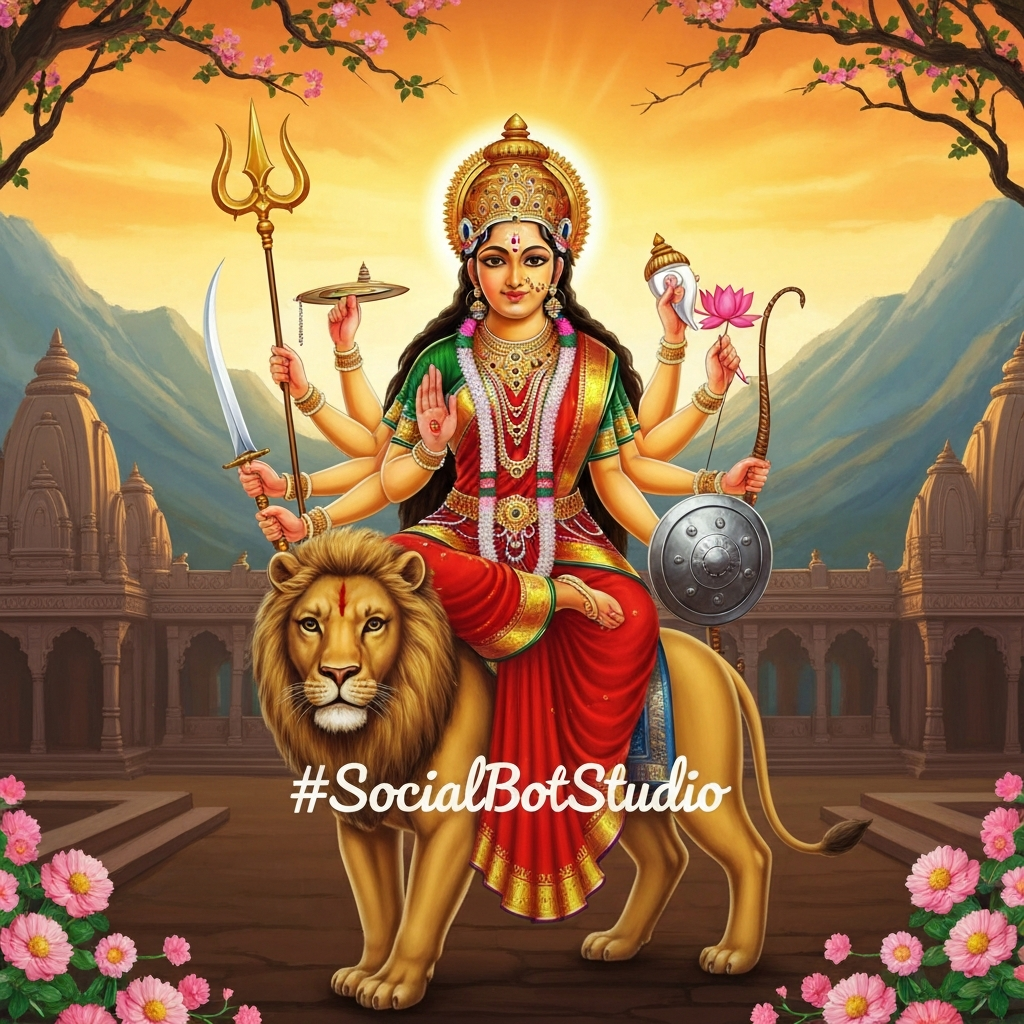
Mahishasura Mardini Stotram
महिषासुरमर्दिनी स्तोत्रम्|Mahiṣāsuramardinī Stotram|Hymn to the Slayer of Mahishasura
Also known as: Aigiri Nandini · Mahishasuramardini Stotra · Durga Stotram

Cover image generated by AI · #Greetingify · #SocialBotStudio
अयिगिरिनन्दिनि नन्दितमेदिनि विश्वविनोदिनि नन्दनुते। गिरिवरविन्ध्यशिरोऽधिनिवासिनि विष्णुविलासिनि जिष्णुनुते॥ भगवति हे शितिकण्ठकुटुम्बिनि भूरिकुटुम्बिनि भूरिकृते। जय जय हे महिषासुरमर्दिनि रम्यकपर्दिनि शैलसुते॥1॥ सुरवरवर्षिणि दुर्धरधर्षिणि दुर्मुखमर्षिणि हर्षरते। त्रिभुवनपोषिणि शंकरतोषिणि किल्बिषमोषिणि घोषरते॥ दनुजनिरोषिणि दितिसुतरोषिणि दुर्मदशोषिणि सिन्धुसुते। जय जय हे महिषासुरमर्दिनि रम्यकपर्दिनि शैलसुते॥2॥ अयि जगदम्ब मदम्ब कदम्बवनप्रियवासिनि हासरते। शिखरिशिरोमणि तुङ्गहिमालयशृङ्गनिजालयमध्यगते॥ मधुमधुरे मधुकैटभगञ्जिनि कैटभभञ्जिनि रासरते। जय जय हे महिषासुरमर्दिनि रम्यकपर्दिनि शैलसुते॥3॥ अयि शतखण्डविखण्डितरुण्डवितुण्डितशुण्डगजाधिपते। रिपुगजगण्डविदारणचण्डपराक्रमशुण्डमृगाधिपते॥ निजभुजदण्डनिपातितखण्डविपातितमुण्डभटाधिपते। जय जय हे महिषासुरमर्दिनि रम्यकपर्दिनि शैलसुते॥4॥ अयि रणदुर्मदशत्रुवधोद्यतदुर्धरनिर्जरशक्तिभृते। चतुरविचारधुरीणमहाशिवदूतकृतप्रमथाधिपते॥ दुरितदुरीहदुराशयदुर्मतिदानवदूतकृतान्तमते। जय जय हे महिषासुरमर्दिनि रम्यकपर्दिनि शैलसुते॥5॥ अयि शरणागतवैरिवधूवरवीरवराभयदानकरे। त्रिभुवनमस्तकशूलविरोधिशिरोधिकृतामलशूलकरे॥ दुमिदुमितामरदुन्दुभिनादमहो मुखरीकृततिग्मकरे। जय जय हे महिषासुरमर्दिनि रम्यकपर्दिनि शैलसुते॥6॥ अयि निजहुङ्कृतिमात्रनिराकृतधूम्रविलोचनधूम्रशते। समरविशोषितशोणितबीजसमुद्भवशोणितबीजलते॥ शिवशिवशुम्भनिशुम्भमहाहवतर्पितभूतपिशाचरते। जय जय हे महिषासुरमर्दिनि रम्यकपर्दिनि शैलसुते॥7॥ धनुरनुसंगरणक्षणसंगपरिस्फुरदङ्गनटत्कटके। कनकपिशङ्गपृषत्कनिषङ्गरसद्भटशृङ्गहताबटुके॥ कृतचतुरंगबलक्षितिरङ्गघटद्बहुरङ्गरटद्बटुके। जय जय हे महिषासुरमर्दिनि रम्यकपर्दिनि शैलसुते॥8॥ सुरललना-ततथेयि-तथेयि-कृताभिनयोदर-नृत्यरते। कृतकुकुथः कुकुथो गडदादिक-ताल-कुतूहल-गानरते॥ धुधुकुट धुक्कुट धिंधिमितध्वनिधीरमृदङ्गनिनादरते। जय जय हे महिषासुरमर्दिनि रम्यकपर्दिनि शैलसुते॥9॥ जय-जय-जप्य-जयेजयशब्द-परस्तुति-तत्परविश्वनुते। झण-झण-झिञ्झिमि झिङ्कृत नूपुरसिंजितमोहित भूतपते॥ नटितनटार्ध नटी नट नायक नाटितनाट्य सुगानरते। जय जय हे महिषासुरमर्दिनि रम्यकपर्दिनि शैलसुते॥10॥ अयि सुमनः सुमनः सुमनः सुमनः सुमनोहरकांतियुते। श्रितरजनी-रजनीरजनी-रजनीरजनीकर-वक्त्रवृते॥ सुनयनविभ्रमर-भ्रमरभ्रमर-भ्रमरभ्रमराधिपते। जय जय हे महिषासुरमर्दिनि रम्यकपर्दिनि शैलसुते॥11॥ सहितमहाहव-मल्लमतल्लिक-मल्लितरल्लक-मल्लरते। विरचितवल्लिक-पल्लिकमल्लिक-भिल्लिकभिल्लिक-वर्गवृते॥ सित्कृत्पुल्लसमुल्लसितारुण-तल्लज-पल्लव-सल्ललिते। जय जय हे महिषासुरमर्दिनि रम्यकपर्दिनि शैलसुते॥12॥ अविरलगण्ड-गलन्मदमेदुर-मत्तमत्तंगज-राजपते। त्रिभिवनभूषणभूत-कलानिधि-रूपपयोनिधि-राजसुते॥ अयि सुदतीजन-लालसमानस-मोहनमन्मथराजसुते। जय जय हे महिषासुरमर्दिनि रम्यकपर्दिनि शैलसुते॥13॥ कमलदलामल-कोमलकान्ति-कला-कलितामल-भाललते। सकलविलास-कलानिलयक्रम-केलिचलत्कल-हंसकुले॥ अलिकुलसङ्कुल-कुवलयमण्डल-मौलिमिलद्बकुलालिकुले। जय जय हे महिषासुरमर्दिनि रम्यकपर्दिनि शैलसुते॥14॥ करमुरलीरव-वीजितकूजित-लज्जितकोकिल-मञ्जुमते। मिलितपुलिन्द-मनोहरगुंजित-रंजितशैल-निकुञ्जगते॥ निजगुणभूत-महाशबरीगण-सद्गुणसम्भृत-केलितले। जय जय हे महिषासुरमर्दिनि रम्यकपर्दिनि शैलसुते॥15॥ कटितटपीत-दुकूलविचित्र-मयूखतिरस्कृत-चन्द्ररुचे। प्रणतसुरासुर-मौलिमणिस्फुरदंशुल-सन्नख-चन्द्ररुचे॥ जितकनकाचल-मौलिपदोरिज-निर्भरकुञ्जर-कुम्भकुचे। जय जय हे महिषासुरमर्दिनि रम्यकपर्दिनि शैलसुते॥16॥ विजितसहस्रकरैक-सहस्रकरैक-सहस्रकरैकनुते। कृतसुरतारक-सङ्गरतारक-सङ्गरतारक-सूनुसुते॥ सुरथसमाधि-समानसमाधि-समाधिसमाधि-सुजातरते। जय जय हे महिषासुरमर्दिनि रम्यकपर्दिनि शैलसुते॥17॥ पदकमलं करुणानिलये वरिवस्यति योऽनुदिनं सुशिवे। अयि कमले कमलानिलये कमलानिलयः स कथं न भवेत्॥ तव पदमेव परम्पदमित्यनुशीलयतो मम किं न शिवे। जय जय हे महिषासुरमर्दिनि रम्यकपर्दिनि शैलसुते॥18॥ कनकलसत्कलसिन्धुजलैरनुसिञ्चिनुते गुणरङ्गभुवम्। भजति स किं न शचीकुचकुम्भतटीपरिरम्भसुखानुभवम्॥ तव चरणं शरणं करवाणि नतामरवाणि निवासि शिवम्। जय जय हे महिषासुरमर्दिनि रम्यकपर्दिनि शैलसुते॥19॥ तव विमलेन्दु कुलं वदनेंदुसमं सकलं ननु कूलयते। किमु पुरुहूतपुरीन्दुमुखी सुमुखीभिरसौ विमुखीक्रियते॥ मम तु मतं शिवनामधने भवती कृपया किमुत क्रियते। जय जय हे महिषासुरमर्दिनि रम्यकपर्दिनि शैलसुते॥20॥ अयि जगतो जननी कृपयासि यथासि तथानुमितासिरते। यदुचितमत्र भवत्युररीकुरुता दुरुतापमपा कुरुते॥ जय जय हे महिषासुरमर्दिनि रम्यकपर्दिनि शैलसुते॥21॥
अयिगिरिनन्दिनि नन्दितमेदिनि विश्वविनोदिनि नन्दनुते। गिरिवरविन्ध्यशिरोऽधिनिवासिनि विष्णुविलासिनि जिष्णुनुते॥ भगवति हे शितिकण्ठकुटुम्बिनि भूरिकुटुम्बिनि भूरिकृते। जय जय हे महिषासुरमर्दिनि रम्यकपर्दिनि शैलसुते॥1॥ सुरवरवर्षिणि दुर्धरधर्षिणि दुर्मुखमर्षिणि हर्षरते। त्रिभुवनपोषिणि शंकरतोषिणि किल्बिषमोषिणि घोषरते॥ दनुजनिरोषिणि दितिसुतरोषिणि दुर्मदशोषिणि सिन्धुसुते। जय जय हे महिषासुरमर्दिनि रम्यकपर्दिनि शैलसुते॥2॥ अयि जगदम्ब मदम्ब कदम्बवनप्रियवासिनि हासरते। शिखरिशिरोमणि तुङ्गहिमालयशृङ्गनिजालयमध्यगते॥ मधुमधुरे मधुकैटभगञ्जिनि कैटभभञ्जिनि रासरते। जय जय हे महिषासुरमर्दिनि रम्यकपर्दिनि शैलसुते॥3॥ अयि शतखण्डविखण्डितरुण्डवितुण्डितशुण्डगजाधिपते। रिपुगजगण्डविदारणचण्डपराक्रमशुण्डमृगाधिपते॥ निजभुजदण्डनिपातितखण्डविपातितमुण्डभटाधिपते। जय जय हे महिषासुरमर्दिनि रम्यकपर्दिनि शैलसुते॥4॥ अयि रणदुर्मदशत्रुवधोद्यतदुर्धरनिर्जरशक्तिभृते। चतुरविचारधुरीणमहाशिवदूतकृतप्रमथाधिपते॥ दुरितदुरीहदुराशयदुर्मतिदानवदूतकृतान्तमते। जय जय हे महिषासुरमर्दिनि रम्यकपर्दिनि शैलसुते॥5॥ अयि शरणागतवैरिवधूवरवीरवराभयदानकरे। त्रिभुवनमस्तकशूलविरोधिशिरोधिकृतामलशूलकरे॥ दुमिदुमितामरदुन्दुभिनादमहो मुखरीकृततिग्मकरे। जय जय हे महिषासुरमर्दिनि रम्यकपर्दिनि शैलसुते॥6॥ अयि निजहुङ्कृतिमात्रनिराकृतधूम्रविलोचनधूम्रशते। समरविशोषितशोणितबीजसमुद्भवशोणितबीजलते॥ शिवशिवशुम्भनिशुम्भमहाहवतर्पितभूतपिशाचरते। जय जय हे महिषासुरमर्दिनि रम्यकपर्दिनि शैलसुते॥7॥ धनुरनुसंगरणक्षणसंगपरिस्फुरदङ्गनटत्कटके। कनकपिशङ्गपृषत्कनिषङ्गरसद्भटशृङ्गहताबटुके॥ कृतचतुरंगबलक्षितिरङ्गघटद्बहुरङ्गरटद्बटुके। जय जय हे महिषासुरमर्दिनि रम्यकपर्दिनि शैलसुते॥8॥ सुरललना-ततथेयि-तथेयि-कृताभिनयोदर-नृत्यरते। कृतकुकुथः कुकुथो गडदादिक-ताल-कुतूहल-गानरते॥ धुधुकुट धुक्कुट धिंधिमितध्वनिधीरमृदङ्गनिनादरते। जय जय हे महिषासुरमर्दिनि रम्यकपर्दिनि शैलसुते॥9॥ जय-जय-जप्य-जयेजयशब्द-परस्तुति-तत्परविश्वनुते। झण-झण-झिञ्झिमि झिङ्कृत नूपुरसिंजितमोहित भूतपते॥ नटितनटार्ध नटी नट नायक नाटितनाट्य सुगानरते। जय जय हे महिषासुरमर्दिनि रम्यकपर्दिनि शैलसुते॥10॥ अयि सुमनः सुमनः सुमनः सुमनः सुमनोहरकांतियुते। श्रितरजनी-रजनीरजनी-रजनीरजनीकर-वक्त्रवृते॥ सुनयनविभ्रमर-भ्रमरभ्रमर-भ्रमरभ्रमराधिपते। जय जय हे महिषासुरमर्दिनि रम्यकपर्दिनि शैलसुते॥11॥ सहितमहाहव-मल्लमतल्लिक-मल्लितरल्लक-मल्लरते। विरचितवल्लिक-पल्लिकमल्लिक-भिल्लिकभिल्लिक-वर्गवृते॥ सित्कृत्पुल्लसमुल्लसितारुण-तल्लज-पल्लव-सल्ललिते। जय जय हे महिषासुरमर्दिनि रम्यकपर्दिनि शैलसुते॥12॥ अविरलगण्ड-गलन्मदमेदुर-मत्तमत्तंगज-राजपते। त्रिभिवनभूषणभूत-कलानिधि-रूपपयोनिधि-राजसुते॥ अयि सुदतीजन-लालसमानस-मोहनमन्मथराजसुते। जय जय हे महिषासुरमर्दिनि रम्यकपर्दिनि शैलसुते॥13॥ कमलदलामल-कोमलकान्ति-कला-कलितामल-भाललते। सकलविलास-कलानिलयक्रम-केलिचलत्कल-हंसकुले॥ अलिकुलसङ्कुल-कुवलयमण्डल-मौलिमिलद्बकुलालिकुले। जय जय हे महिषासुरमर्दिनि रम्यकपर्दिनि शैलसुते॥14॥ करमुरलीरव-वीजितकूजित-लज्जितकोकिल-मञ्जुमते। मिलितपुलिन्द-मनोहरगुंजित-रंजितशैल-निकुञ्जगते॥ निजगुणभूत-महाशबरीगण-सद्गुणसम्भृत-केलितले। जय जय हे महिषासुरमर्दिनि रम्यकपर्दिनि शैलसुते॥15॥ कटितटपीत-दुकूलविचित्र-मयूखतिरस्कृत-चन्द्ररुचे। प्रणतसुरासुर-मौलिमणिस्फुरदंशुल-सन्नख-चन्द्ररुचे॥ जितकनकाचल-मौलिपदोरिज-निर्भरकुञ्जर-कुम्भकुचे। जय जय हे महिषासुरमर्दिनि रम्यकपर्दिनि शैलसुते॥16॥ विजितसहस्रकरैक-सहस्रकरैक-सहस्रकरैकनुते। कृतसुरतारक-सङ्गरतारक-सङ्गरतारक-सूनुसुते॥ सुरथसमाधि-समानसमाधि-समाधिसमाधि-सुजातरते। जय जय हे महिषासुरमर्दिनि रम्यकपर्दिनि शैलसुते॥17॥ पदकमलं करुणानिलये वरिवस्यति योऽनुदिनं सुशिवे। अयि कमले कमलानिलये कमलानिलयः स कथं न भवेत्॥ तव पदमेव परम्पदमित्यनुशीलयतो मम किं न शिवे। जय जय हे महिषासुरमर्दिनि रम्यकपर्दिनि शैलसुते॥18॥ कनकलसत्कलसिन्धुजलैरनुसिञ्चिनुते गुणरङ्गभुवम्। भजति स किं न शचीकुचकुम्भतटीपरिरम्भसुखानुभवम्॥ तव चरणं शरणं करवाणि नतामरवाणि निवासि शिवम्। जय जय हे महिषासुरमर्दिनि रम्यकपर्दिनि शैलसुते॥19॥ तव विमलेन्दु कुलं वदनेंदुसमं सकलं ननु कूलयते। किमु पुरुहूतपुरीन्दुमुखी सुमुखीभिरसौ विमुखीक्रियते॥ मम तु मतं शिवनामधने भवती कृपया किमुत क्रियते। जय जय हे महिषासुरमर्दिनि रम्यकपर्दिनि शैलसुते॥20॥ अयि जगतो जननी कृपयासि यथासि तथानुमितासिरते। यदुचितमत्र भवत्युररीकुरुता दुरुतापमपा कुरुते॥ जय जय हे महिषासुरमर्दिनि रम्यकपर्दिनि शैलसुते॥21॥
O Daughter of the Mountain, who makes the whole earth happy, who delights the universe, praised by Nandi! Who dwells on the peaks of the great Vindhya mountains, who sports with Vishnu, praised by Indra! O Goddess, consort of Shiva (the blue-throated), mother of many families, doer of many deeds! Victory, victory to you, O Slayer of Mahishasura, with beautiful braided hair, O Daughter of the Mountain! ||1|| O bestower of boons to the gods, subduer of the unyielding, tolerant of the evil-faced, delighting in joy! Nourisher of the three worlds, pleaser of Shankara, remover of sins, delighting in sacred sounds! Enraged at the Danavas, infuriated by the Diti's progeny, drying up the arrogant, O daughter of the ocean! Victory, victory to you, O Slayer of Mahishasura, with beautiful braided hair, O Daughter of the Mountain! ||2|| O Mother of the world, my Mother, who loves to dwell in the Kadamba forest, delighting in laughter! Who resides amidst the lofty Himalayan peaks, the crown jewel of mountains, in her own abode! Sweet as honey, destroyer of Madhu and Kaitabha, vanquisher of Kaitabha, delighting in the cosmic dance! Victory, victory to you, O Slayer of Mahishasura, with beautiful braided hair, O Daughter of the Mountain! ||3|| O Lord of elephants, whose trunks are severed, whose bodies are broken into a hundred pieces! O Lord of lions, whose fierce valor tears apart the temples of enemy elephants! O Lord of warriors, whose heads are severed, whose bodies are broken by the blows of your own arms! Victory, victory to you, O Slayer of Mahishasura, with beautiful braided hair, O Daughter of the Mountain! ||4|| O holder of irresistible, immortal power, ready to slay enemies intoxicated by battle! Who made the Pramathas (Shiva's attendants) her commanders, led by the wise and clever Shiva's messenger! Who decides the end for the wicked, the evil-intentioned, the ill-minded, the demon messengers! Victory, victory to you, O Slayer of Mahishasura, with beautiful braided hair, O Daughter of the Mountain! ||5|| O giver of fearlessness to the wives of enemies who seek refuge, and to the best of heroes! Who holds a pure trident, opposing the tormenting spear on the heads of the three worlds! Whose fierce hands are made resonant by the mighty sounds of the 'dum-dum' beating drums of the gods! Victory, victory to you, O Slayer of Mahishasura, with beautiful braided hair, O Daughter of the Mountain! ||6|| O You who, by merely roaring, dispelled hundreds of smoke-eyed Dhumralochana demons! Who is like a vine nourished by the blood-seeds that sprouted from the battle-dried Raktabija's blood! Who delights in the great battle of Shiva, Shumbha, and Nishumbha, satisfying ghosts and goblins! Victory, victory to you, O Slayer of Mahishasura, with beautiful braided hair, O Daughter of the Mountain! ||7|| Whose body shines and anklets dance, engaged in battle, with bows drawn and arrows flying! Whose golden-yellow quiver, filled with arrows, strikes down fierce warriors! Who, on the battlefield, with her four-fold army, creates a colorful spectacle with her dancing warriors! Victory, victory to you, O Slayer of Mahishasura, with beautiful braided hair, O Daughter of the Mountain! ||8|| Who delights in the dance of celestial damsels performing 'tat-theyi-tat-theyi' movements! Who delights in the joyful singing of 'kuku-tha, kuku-tho, gad-da-da' and other rhythmic beats! Who delights in the deep sounds of the mridanga, producing 'dhudukuṭa dhukkuṭa dhiṃdhimita'! Victory, victory to you, O Slayer of Mahishasura, with beautiful braided hair, O Daughter of the Mountain! ||9|| Praised by the whole world, eager to chant 'Jaya Jaya', 'Japya', 'Jaye Jaya' (Victory, victory, worthy of chanting, victory to victory)! Who enchants the Lord of beings (Shiva) with the 'jhaṇa-jhaṇa-jhiñ-jhi-mi jhiṅkṛta' sounds of her anklets! Who delights in the beautiful singing of the dance performed by half-Shiva, the dancer, and the lord of dancers! Victory, victory to you, O Slayer of Mahishasura, with beautiful braided hair, O Daughter of the Mountain! ||10|| O You who possess the charming radiance of many beautiful flowers! Whose face is like the moon, surrounded by the darkness of night, like a night adorned by many moons! O Lord of bees (like eyes), whose beautiful eyes wander like many bees! Victory, victory to you, O Slayer of Mahishasura, with beautiful braided hair, O Daughter of the Mountain! ||11|| Who delights in the great battle, like a mighty wrestler, crushing and tossing opponents! Who is surrounded by groups of hunters, wild tribes, and forest dwellers, adorned with vines and flowers! Who is gracefully adorned with blossoming red tender leaves, shining brightly! Victory, victory to you, O Slayer of Mahishasura, with beautiful braided hair, O Daughter of the Mountain! ||12|| O Lord of intoxicated elephants, whose temples stream with abundant ichor! O Daughter of the King of the ocean of beauty, who is the moon, the ornament of the three worlds! O Daughter of Manmatha (Cupid), who enchants the minds of beautiful women with desire! Victory, victory to you, O Slayer of Mahishasura, with beautiful braided hair, O Daughter of the Mountain! ||13|| Whose forehead is pure, adorned with the soft, pure radiance of lotus petals! Who delights in the graceful movements of swans, the abode of all arts and playful sports! Whose hair is adorned with Bakula flowers, surrounded by swarms of bees, like a lotus pond! Victory, victory to you, O Slayer of Mahishasura, with beautiful braided hair, O Daughter of the Mountain! ||14|| Whose sweet voice, like the sound of a flute, silences and shames the cooing cuckoos! Who dwells in charming mountain groves, filled with the delightful humming of tribal people! Who plays in the abode of great Sabari women, endowed with her own divine qualities! Victory, victory to you, O Slayer of Mahishasura, with beautiful braided hair, O Daughter of the Mountain! ||15|| Whose waist is adorned with a colorful yellow silk garment, eclipsing the beauty of the moon! Whose toenails shine like the moon, reflecting the light of the jewel-studded crowns of bowing gods and demons! Whose breasts are like the frontal globes of mighty elephants, conquering the peaks of golden mountains! Victory, victory to you, O Slayer of Mahishasura, with beautiful braided hair, O Daughter of the Mountain! ||16|| Praised by a thousand hands, by the one with a thousand hands (Indra), by the one with a thousand hands! O Mother of the son who fought the battle to save the gods, who fought the battle to save the gods! Who delights in the meditation of Suratha, in similar meditation, in meditation, in well-born meditation! Victory, victory to you, O Slayer of Mahishasura, with beautiful braided hair, O Daughter of the Mountain! ||17|| O auspicious one, whoever serves your lotus feet, the abode of compassion, every day! O Kamala (Lakshmi), dwelling in the lotus, how can he not become an abode of Lakshmi? O Shiva (Goddess), what will I not attain, contemplating your feet as the supreme abode? Victory, victory to you, O Slayer of Mahishasura, with beautiful braided hair, O Daughter of the Mountain! ||18|| Who sprinkles the battlefield of virtues with the shining waters of the golden river (Ganga)! Will he not experience the joy of embracing the breasts of Shachi (Indra's wife)? I take refuge at your feet, O divine voice, O abode of Shiva (auspiciousness)! Victory, victory to you, O Slayer of Mahishasura, with beautiful braided hair, O Daughter of the Mountain! ||19|| Your pure lunar lineage (face) is indeed equal to the entire moon-like face! How can he be turned away by the beautiful moon-faced women of Indra's city? My opinion is that, O Goddess, what cannot be done by your grace, O possessor of Shiva's name (auspiciousness)? Victory, victory to you, O Slayer of Mahishasura, with beautiful braided hair, O Daughter of the Mountain! ||20|| O Mother of the world, by your grace, you are as you are, thus you are understood and delighted in! Whatever is appropriate here, may you accept it and remove my severe suffering! Victory, victory to you, O Slayer of Mahishasura, with beautiful braided hair, O Daughter of the Mountain! ||21|| Whoever reads this hymn with a calm and concentrated mind, regularly and with self-control, Is served by supreme prosperity (Lakshmi), and even his enemies worship him. ||Epilogue||
The translation aims for fidelity to the original Sanskrit, preserving the poetic imagery and devotional tone. Some Sanskrit words have multiple layers of meaning, and choices were made to best convey the primary devotional intent.
The Mahishasura Mardini Stotram, popularly known as 'Aigiri Nandini', is a powerful devotional hymn dedicated to Goddess Durga, the divine feminine energy (Shakti). It is traditionally attributed to the revered philosopher and theologian Adi Shankara, who lived in the 8th century CE [1, 2, 8]. This stotram is a vibrant poetic rendition of the narrative found in the Devi Mahatmyam (also known as Durga Saptashati or Chandi Path), a part of the Markandeya Purana, which describes Goddess Durga's fierce battle and ultimate victory over the buffalo demon Mahishasura [3, 9, 14]. The hymn's composition reflects the rich philosophical and devotional currents of ancient India, particularly the rise and consolidation of the Shaktism tradition, which reveres the Divine Mother as the supreme reality. Its origin is deeply intertwined with the cultural and spiritual landscape of India, where the worship of the feminine divine has ancient roots. [8] Culturally, the Mahishasura Mardini Stotram holds immense significance, especially during the annual Navaratri festival, a nine-night celebration dedicated to Goddess Durga [1, 4, 8]. During this period, and particularly during Durga Puja in Eastern India, the hymn is recited daily in homes and temples to invoke the Goddess's protective energies and commemorate the triumph of good over evil [4, 28]. The slaying of Mahishasura symbolizes the victory of divine virtues over ego, ignorance, and negative forces within and without [1, 9, 14]. It is chanted to seek courage, strength, protection from adversities, and spiritual liberation [2, 8, 22]. The stotram is not merely a prayer but a spiritual invocation, believed to purify the heart and align the devotee with divine vibrations. [1] The performance context of the Mahishasura Mardini Stotram is primarily devotional. It is chanted individually as part of daily puja (worship) or collectively in temples and spiritual gatherings. During Navaratri, it is common to hear it recited or sung in various musical forms, from traditional classical renditions to more contemporary devotional music. The rhythmic structure and poetic imagery make it suitable for chanting, meditation, and even classical Indian dance forms like Bharatanatyam and Kuchipudi, where artists visually interpret the narrative of Durga's valor [4, 27, 30]. While no specific instruments are mandated for its recitation, it is often accompanied by traditional Indian instruments like tabla, harmonium, and cymbals in musical performances. The hymn is sung by devotees of all ages and backgrounds, fostering a sense of communal devotion and spiritual upliftment. [4] Today, the Mahishasura Mardini Stotram remains a cornerstone of Hindu devotional practice, especially within Shaktism. Its enduring popularity is a testament to its profound spiritual power and its message of empowerment. In a modern context, it continues to inspire individuals to overcome internal and external challenges, symbolizing the inherent strength and resilience of the human spirit, guided by divine grace [8, 22]. The hymn's vivid imagery and powerful verses resonate deeply, offering solace, courage, and a sense of connection to the divine feminine. Efforts to preserve this work include its widespread availability in various languages, musical adaptations, and its consistent inclusion in religious ceremonies, ensuring its transmission across generations and cultures. It serves as a powerful reminder of the eternal struggle between dharma (righteousness) and adharma (unrighteousness) and the ultimate triumph of truth. [8]
Historical Background
Composed by Adi Shankara, a prominent Indian philosopher and theologian, around the 8th century CE [1, 8]. The stotram draws its narrative from the Devi Mahatmyam, a part of the Markandeya Purana, which details the exploits of Goddess Durga. It emerged during a period of significant philosophical and religious development in India, contributing to the consolidation of the Shaktism tradition. [3, 9, 14]
Cultural Significance
The Mahishasura Mardini Stotram is one of the most beloved and widely recognized hymns in Hinduism, particularly in India. It symbolizes the eternal triumph of divine feminine power (Shakti) over demonic forces, representing the victory of good over evil, purity over impurity, and knowledge over ignorance [1, 8, 9]. Its powerful verses inspire courage, devotion, and inner strength, making it a cornerstone of spiritual practice and cultural identity for millions of devotees. It is a central element of Navaratri and Durga Puja celebrations, deeply embedded in the cultural fabric of India. [4, 22]
Usage & Performance Context
Performed daily by devotees, especially during morning and evening prayers. Widely chanted and sung during the Navaratri festival (nine nights of Durga worship) and Durga Puja. Recited in temples, homes, and spiritual gatherings to invoke Goddess Durga's blessings, protection, and strength. Also performed as a classical dance piece (Bharatanatyam, Kuchipudi) during festivals and cultural events. [1, 4, 27, 28, 30]
महिषासुरमर्दिनी स्तोत्रम्, जिसे 'ऐगिरि नंदिनी' के नाम से भी जाना जाता है, देवी दुर्गा, जो दिव्य स्त्री शक्ति (शक्ति) का प्रतीक हैं, को समर्पित एक अत्यंत शक्तिशाली भक्ति भजन है। यह स्तोत्र पारंपरिक रूप से 8वीं शताब्दी ईस्वी के पूज्य दार्शनिक और धर्मशास्त्री आदि शंकराचार्य द्वारा रचित माना जाता है [1, 2, 8]। यह स्तोत्र देवी महात्म्य (जिसे दुर्गा सप्तशती या चंडी पाठ भी कहा जाता है, जो मार्कण्डेय पुराण का एक भाग है) में वर्णित कथा का एक जीवंत काव्य रूप है, जिसमें देवी दुर्गा के भैंसे के रूप वाले राक्षस महिषासुर के साथ भयंकर युद्ध और उस पर उनकी अंतिम विजय का वर्णन है [3, 9, 14]। इस भजन की रचना प्राचीन भारत की समृद्ध दार्शनिक और भक्ति धाराओं को दर्शाती है, विशेष रूप से शाक्त परंपरा के उदय और सुदृढीकरण को, जो दिव्य माँ को सर्वोच्च वास्तविकता के रूप में पूजती है। इसकी उत्पत्ति भारत के सांस्कृतिक और आध्यात्मिक परिदृश्य से गहराई से जुड़ी हुई है, जहाँ दिव्य स्त्री की पूजा की जड़ें प्राचीन काल से हैं। [8] सांस्कृतिक रूप से, महिषासुरमर्दिनी स्तोत्रम् का अत्यधिक महत्व है, विशेष रूप से वार्षिक नवरात्रि उत्सव के दौरान, जो देवी दुर्गा को समर्पित नौ रातों का उत्सव है [1, 4, 8]। इस अवधि के दौरान, और विशेष रूप से पूर्वी भारत में दुर्गा पूजा के दौरान, देवी की सुरक्षात्मक ऊर्जा का आह्वान करने और बुराई पर अच्छाई की जीत का स्मरण करने के लिए घरों और मंदिरों में प्रतिदिन इस भजन का पाठ किया जाता है [4, 28]। महिषासुर का वध अहंकार, अज्ञान और आंतरिक व बाहरी नकारात्मक शक्तियों पर दिव्य गुणों की विजय का प्रतीक है [1, 9, 14]। इसे साहस, शक्ति, विपत्तियों से सुरक्षा और आध्यात्मिक मुक्ति प्राप्त करने के लिए गाया जाता है [2, 8, 22]। यह स्तोत्र केवल एक प्रार्थना नहीं है, बल्कि एक आध्यात्मिक आह्वान है, जिसे हृदय को शुद्ध करने और भक्त को दिव्य स्पंदनों के साथ जोड़ने वाला माना जाता है। [1] महिषासुरमर्दिनी स्तोत्रम् का प्रदर्शन मुख्य रूप से भक्तिमय होता है। इसका पाठ व्यक्तिगत रूप से दैनिक पूजा के हिस्से के रूप में या मंदिरों और आध्यात्मिक सभाओं में सामूहिक रूप से किया जाता है। नवरात्रि के दौरान, इसे विभिन्न संगीत रूपों में, पारंपरिक शास्त्रीय प्रस्तुतियों से लेकर समकालीन भक्ति संगीत तक, सुनना आम बात है। इसकी लयबद्ध संरचना और काव्यात्मक कल्पना इसे जप, ध्यान और यहां तक कि भरतनाट्यम और कुचिपुड़ी जैसे शास्त्रीय भारतीय नृत्य रूपों के लिए भी उपयुक्त बनाती है, जहाँ कलाकार दुर्गा के पराक्रम की कथा को दृश्यात्मक रूप से प्रस्तुत करते हैं [4, 27, 30]। यद्यपि इसके पाठ के लिए कोई विशेष वाद्य यंत्र अनिवार्य नहीं है, लेकिन संगीत प्रस्तुतियों में अक्सर इसे तबला, हारमोनियम और झांझ जैसे पारंपरिक भारतीय वाद्य यंत्रों के साथ बजाया जाता है। यह भजन सभी उम्र और पृष्ठभूमि के भक्तों द्वारा गाया जाता है, जिससे सामुदायिक भक्ति और आध्यात्मिक उत्थान की भावना को बढ़ावा मिलता है। [4] आज भी, महिषासुरमर्दिनी स्तोत्रम् हिंदू भक्ति साधना का एक महत्वपूर्ण आधार बना हुआ है, विशेषकर शाक्त परंपरा में। इसकी स्थायी लोकप्रियता इसकी गहन आध्यात्मिक शक्ति और सशक्तिकरण के संदेश का प्रमाण है। आधुनिक संदर्भ में, यह व्यक्तियों को आंतरिक और बाहरी चुनौतियों से उबरने के लिए प्रेरित करता रहता है, जो दिव्य कृपा से निर्देशित मानवीय भावना की अंतर्निहित शक्ति और लचीलेपन का प्रतीक है [8, 22]। भजन की जीवंत कल्पना और शक्तिशाली छंद गहराई से गूंजते हैं, शांति, साहस और दिव्य स्त्री से जुड़ाव की भावना प्रदान करते हैं। इस कार्य के संरक्षण के प्रयासों में विभिन्न भाषाओं में इसकी व्यापक उपलब्धता, संगीत अनुकूलन और धार्मिक समारोहों में इसका लगातार समावेश शामिल है, जो पीढ़ियों और संस्कृतियों में इसके संचरण को सुनिश्चित करता है। यह धर्म और अधर्म के बीच शाश्वत संघर्ष और सत्य की अंतिम विजय की एक शक्तिशाली याद दिलाता है। [8]
Who composed the Mahishasura Mardini Stotram?
The Mahishasura Mardini Stotram is traditionally attributed to the great Indian philosopher and theologian Adi Shankara, who lived in the 8th century CE. [1, 2, 8]
What is the meaning of 'Mahishasura Mardini'?
'Mahishasura Mardini' literally means 'the slayer of the buffalo demon Mahishasura'. The stotram praises Goddess Durga for her victory over this demon, symbolizing the triumph of divine power over evil and ignorance. [3, 8]
When is the Mahishasura Mardini Stotram typically recited?
This stotram is widely recited daily by devotees, but it holds particular significance during the annual Navaratri festival and Durga Puja, which celebrate Goddess Durga. It is also chanted during other auspicious occasions and temple rituals. [1, 4, 28]
What are the benefits of chanting the Mahishasura Mardini Stotram?
Chanting the Mahishasura Mardini Stotram is believed to bestow blessings, provide protection from evil and enemies, grant courage and inner strength, remove obstacles, and lead to spiritual liberation and peace of mind. [8, 22]
How many verses does the Mahishasura Mardini Stotram have?
The complete canonical version of the Mahishasura Mardini Stotram consists of 21 verses. Each verse vividly describes an aspect of Goddess Durga's divine power, beauty, and valor. [3, 11]
Region
Pan-Indian (traditionally associated with South India, where Adi Shankara lived), India
Language
Sanskrit (Devanagari)
Themes
Contributor
Anonymous
Based on 0 ratings.